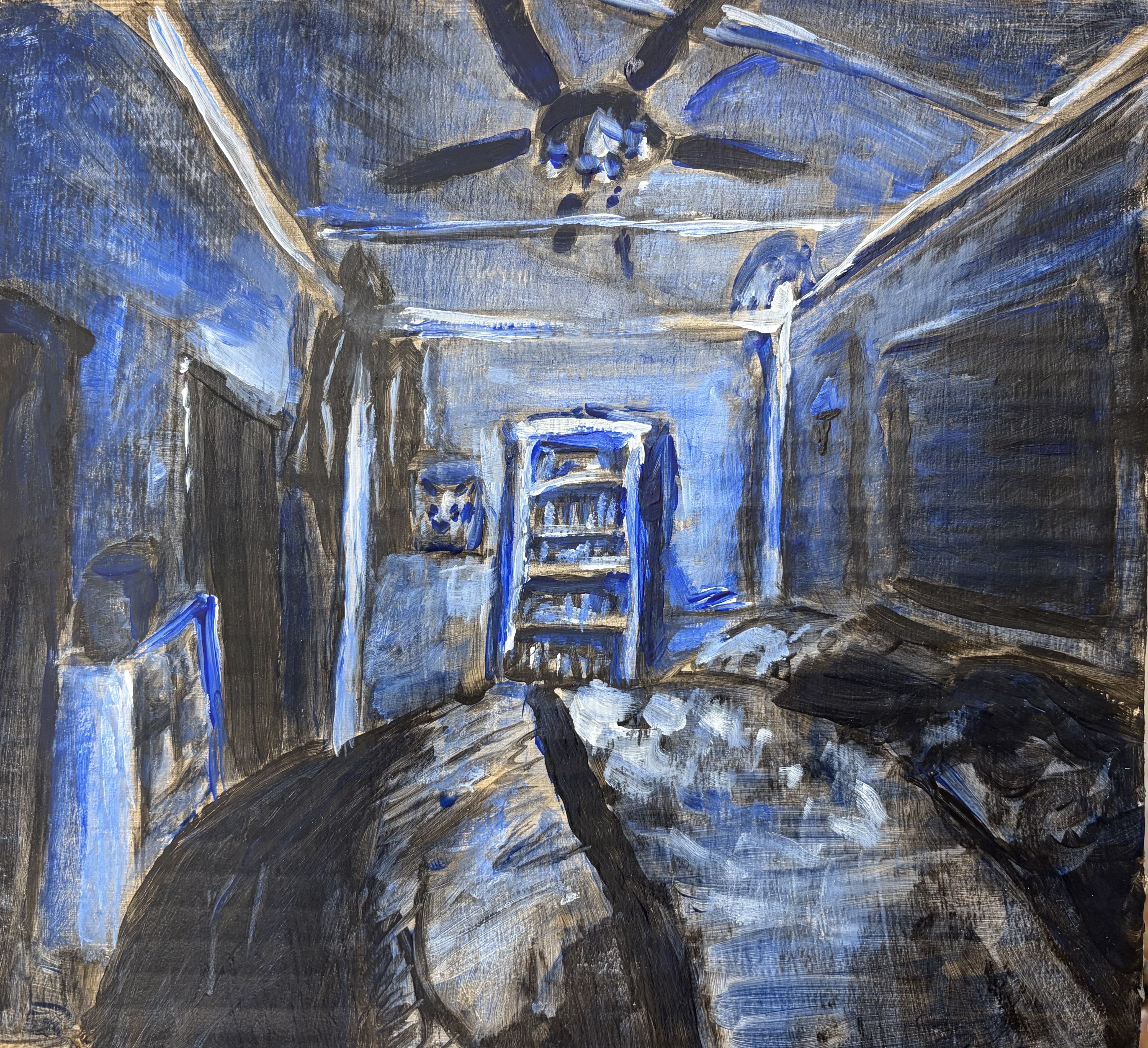
“Hell is other people:” Jean-Paul Sartre’s oft-quoted diatribe remains ever relevant, both in its revelations and its exceptions. Sartre’s No Exit embodies and expands upon its signature quote by introducing 3 postmortem protagonists who are damned to a familiar hell; not a hell of sweat and chains, of flames or jagged knives, but rather the mundane discomfort of each others’ eternal company without the respite of night.
Although Inez, Garcin, and Estelle torment each other throughout the play, each refuses to leave the comfortable suffering of their shared drawing room to seek the unknown, suggesting that people behave similarly in life, allowing fear of solitude and the unknown to drive them to uncomfortable and even tortuous relationships. Garcin himself claims: “Anything, anything would be better than this agony of mind, this creeping pain that gnaws and fumbles and caresses one and never hurts quite enough.” However, when the door opens, revealing an unknowable future, Garcin chooses to remain with Inez and Estelle, as his compatriots choose to remain with him.
But what exactly is so horrible about the unknown? The unknown is a gamble, offering either unquenchable doom or unfathomable beauty; surely it should be equally addictive as a casino roulette wheel. The appeal of the roulette wheel lies in its simplicity: a reward provides a dopamine burst whereas a loss does not trigger stress hormones to flood the brain. The outcome is known, just out of reach; a far cry from the uncertainties of the unknown, the mere existence of which floods the brain with stress hormones. From an evolutionary perspective, the known only brings torment, while the unknown could bring death. Imagination floods the mind, showing different possibilities of doom, paralyzing even the most adept enactor. In this sense, a powerful story can overcome a lived experience.
Similar to how an immediate fear overcomes a more realistic one (such as fear of lost profit overshadowing the fear of climate change), the fear of the unknown introduces a vague but immediate danger, whereas the known scenario suggests a prolonged torment. Sartre’s No Exit implicitly suggests that although “hell is other people,” it is a hell we voluntarily choose, out of fear of solitude. In other words, we are afraid of ourselves, and of spending time with ourselves, so we choose to spend time with others as a distraction.
This becomes strikingly clear as Estelle thrusts herself toward Garcin with romantic intent, even as Inez expresses her own attraction to Estelle. No Exit depicts romance as a distraction from one’s own thoughts and enemies; it becomes increasingly clear that the connection between Garcin and Estelle is superficial and solely constructed to comfort.
Estelle and Inez are both characterized by seeking relationships, suggesting that Sartre appears to depict women as reliant on others for comfort in No Exit. However, while Estelle uses male attention to boost her own ego, in the sense that she feels reflected by (male) attention and does not feel real without it, Inez is bold in her attraction to Estelle and acts as a driver in her own relationships, which complements the fact that she seeks Estelle in an effort to control her (after)life and feel powerful. When Estelle is using Inez’s pupils as a mirror, Inez tells her: “Suppose the mirror started telling lies? Or suppose I covered my eyes—as he is doing—and refused to look at you, all that loveliness would be wasted on the desert air.” In saying this, Inez reveals that she seeks power over Estelle, and her comfort is in the sense of control rather than in attention, thus showing that Sartre’s depiction of women is more nuanced than I originally suggested. Thus the problem of ill representation is solved: if a woman (or a blind person, or a member of any other underrepresented population) is a poor and stereotypical representative, write another.
No Exit resonates as the inspiration for works of modern media, such as The Good Place, a TV show about the afterlife. Beware of spoilers for The Good Place ahead. In The Good Place, the main characters discover at the end of the first season that the neighborhood they thought of as the “Good Place” was actually an elaborate setup designed to make them torment each other, as in Sartre’s No Exit. However, in The Good Place, Eleanor, Chidi, Jason, and Tahani become better people by learning from each other and their experiences. In contrast, Inez, Garcin, and Estelle simply torment each other, perhaps even making each other worse. The Good Place shows a logical conclusion to No Exit: although “hell is other people,” other people can teach us to become better, to make our own heaven.


Leave a Reply