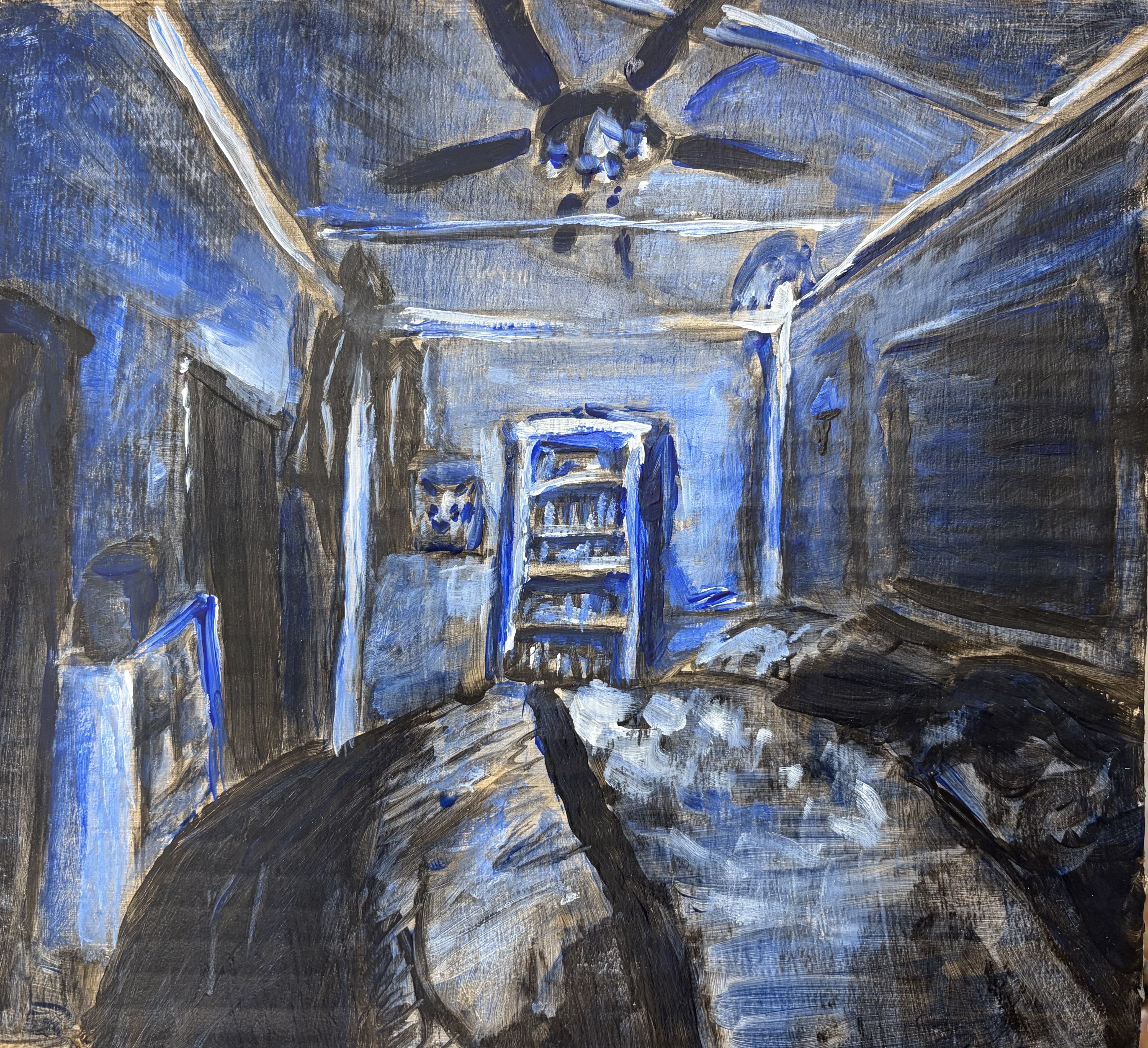
Hardly rare is the wretched blogger’s voice that dares review Macbeth. The play has been analyzed by academics with storied careers and children freshly learning the definition of “iambic pentameter” alike; it pulls us like the moon pulls the tides in a great bulge on either side of the iron rock that wrought us. Nevertheless, I shall attempt a fresh perspective on Macbeth.
Quit your whinging, thespians. I said Macbeth, and I’ll say Macbeth, and hell upon us both.
For the uninformed, Macbeth, also known as the Scottish Play, is considered cursed in the realm of theatre. Whether this is due to the reigning king’s persecution of witchcraft or the companies’ tendency to use this popular play to bolster income in times of financial trouble, it is difficult to say, but legend has it the original performance was riddled with disaster and plagued with multiple real life deaths [1]. The legend of the curse disseminated, and now, most embroiled in the realm of theatre are unwilling to say the word in the vicinity of a stage. Of course, when all the world’s a stage and all the men and women merely players, it can be daunting for the initiated to say “Macbeth” at all.
How so, when Macbeth and his costars were real men who roamed the fen of Scotland? Yes, Macbeth walked the Earth, as did Macduff, Banquo, and Duncan, though not in the manner in which they appear before us within the play itself. Although Shakespeare took great inspiration from Raphael Holinshed’s Historie Of Scotland, he altered the tale to craft a great story—and protect himself from royal retribution. King James I of England (and VI of Scotland) believed himself to be a direct descendant of Banquo, and so Shakespeare edited the story to disinclude Banquo as a co-conspirator in the murder of Duncan, which was his role according to Holinshed [2].
This background immediately clarifies Banquo’s role in Macbeth. Although Banquo’s son escapes rending mastication in the jaws of his father’s fate, he plays little to no role in the subsequent scenes. Why then, a reader wonders, why ruminate on Banquo and his sons? Surely such a figure should loom large in the fate of the play, yet Banquo’s son Fleance flees from certain doom and the audience does not see him again. The question itself demonstrates the widening context gap betwixt the reader and a Shakespearean audience: Banquo did loom large to them, as the ancestor of their king, James I, and as originator to the line of Scottish royalty. In Act 4, Scene 1, the witches show Macbeth that the throne will pass to the descendants of Banquo: a striking scene already without historical perspective, but in context, transformed. Oh, how that scene must have pleased King James himself! The ruin of Macbeth, to his benefit!
If Macbeth and the others were real men, the weyard sisters are the chorus, making explicit the black and deep desires of Macbeth. In Greek theatre, a chorus acts to provide exposition, reactions, and entertainment to the audience, thus aligning themselves with the audience as a reactor outside the scope of the play [3]. However, the weyard sisters, as a chorus, are emotionally opaque, and act to probe the darkness within Macbeth, spurring the plot ever onward. This creates a line of distinction between the sisters and the audience; a very necessary line when one considers King James’ “tough on witchcraft” policies. Furthermore, Shakespeare poses the sisters’ sorceries in a negative light, furthering the political agenda of anti-witchcraft rhetoric. However, the Bard never refers to the sisters themselves as witches, allowing them to play outside of traditional punishment [4].
Conformity to royal perspectives sparks perhaps the greatest failing of the play. In Act 4, Scene 1, the weyard sisters also manifest various prophecies to Macbeth, including hence: “be bloody, bold, and resolute: laugh to scorn the power of man, for none of woman-born shall harm Macbeth.” Although the prophecy declares that men born from women have no power to harm Macbeth, a man born of C-section slays Macbeth rather than the obvious choice: a woman. This decision leaves Lady Macbeth to die ignobly offstage, rather than defending or destroying her husband, or acting autonomously in any way. Although Lady Macbeth is praised for her “masculine virtues,” she is inevitably subdued by the narrative in a fit of “feminine” aligned madness. This reaffirms Jacobian era gender roles, which King James perpetuated: although the nature of his relationship with his male favorites was likely sexual, he aligned with the social order and railed against sodomy (which was considered a disruption of the social order).
Conversely, the greatest strength of Macbeth lies in Shakespeare’s subversion of the social order; namely, in including the weyard sisters at all, regardless of their obvious sorcery. Act 4, Scene 1, oft referenced in this article, is the single most impactful scene in the entire play, and it is entirely dominated by sorcery and prophecy.
King James’ condemnation of sorcery may have driven the fascination with witches, inspiring Shakespeare to include the weyard sisters in Macbeth. For modern comparison, one needs look no further than America’s condemnation of trans people and its simultaneous adoration of shows like Rupaul’s Drag Race and explicit materials including trans people, which rose 75% in popularity in 2022 and continues to rise in correlation with nationwide transphobia [5]. A nation’s fear begets fascination.
Although Shakespeare’s Macbeth viscerally demonstrates the dangers of conformity to aspirant writers, it is also one of the most successful tragedies of all time. Despite his sponsor’s implicit constraints, Shakespeare produced a successful play, which may not have been possible had he subverted the social order. Despite that, a full subversion of traditional roles would have doubtlessly produced a more compelling play, proving once and for all that universal audience reception has less to do with artistic merit than artists might assume.
[1] https://www.rsc.org.uk/macbeth/about-the-play/the-scottish-play
[2] https://www.bellshakespeare.com.au/macbeth-historical-background-2
[3] https://people.wou.edu/~aarndt08/myweb/Chorus.html
[5] https://www.them.us/story/trans-porns-pornhub-popularity
Originally published through substack
None of my writing will ever use AI in any form.


Leave a Reply